
The calculation of greenhouse gas emissions is firmly embedded in the European Sustainability Reporting Standards (ESRS), specifically in Chapter E1 – Climate Change, and follows the rules of the GHG Protocol standard.The first version of the ESRS assumed that companies would quantify their carbon footprint, and this requirement is also retained in the revised draft. The reason lies in the seriousness of scientific findings on climate change and its impacts on the environment, society, and the economy.
.webp)
Managers of companies that have calculated their carbon footprint for the first time often ask whether the resulting figures are “good” or “bad” and what to do with them next. A simple answer suggests itself: once emissions have been measured, a plan to reduce them should follow. In practice, however, the situation is more complex. Initial calculations are often based on less precise data, and some inputs – particularly from suppliers – may not be available at all. For this reason, it is advisable to focus first on improving data quality and availability before moving on to setting specific targets.
Once a company has high-quality data in place, it can begin working on its climate transition plan. Today, such plans are most commonly based on the methodology of the Science Based Targets initiative (SBTi), which defines so-called net-zero targets. The concept of “net zero” gained broader prominence following the Paris Agreement in 2015, which set a global goal to limit warming to well below 2 °C, and ideally to 1.5 °C. A key milestone was the Intergovernmental Panel on Climate Change (IPCC) scenario published in 2018, which demonstrated that achieving this goal requires global carbon neutrality around the year 2050.
To prevent the term “net zero” from becoming nothing more than an empty promise, the need for clear rules emerged. In 2021, the SBTi Net-Zero Standard was therefore published, defining what a credible climate commitment truly means. Companies that align with the standard must set both short-term and long-term targets, reduce absolute emissions by 90–95% by 2050, and compensate the remaining maximum 5–10% exclusively through permanent carbon removal.
In addition to SBTi, other approaches also exist – for example, The Climate Pledge, which allows for greater flexibility but may not be aligned with the scientific 1.5°C pathway. Another framework that seeks to standardize the concept of “net zero” is ISO 14068-1:2023.
.webp)
Approaches to defining climate targets differ across frameworks not only in terminology, but above all in methodological rigor. The SBTi Net-Zero Standard defines a science-based target for achieving climate neutrality that requires the inclusion of all three emission scopes – Scope 1, 2, and 3, with Scope 3 being mandatory if it accounts for more than 40% of total emissions. Offsets are permitted under this framework only for unavoidable residual emissions and exclusively in the form of permanent carbon removals. Targets must be validated directly by SBTi, and companies are required to regularly disclose their progress.
By contrast, ISO 14068-1:2023 works with the concept of carbon neutrality, requiring the inclusion of Scope 1 and Scope 2 emissions, while Scope 3 is recommended. Offsetting is permitted for residual emissions provided that the offsets are verified, and validation is carried out through third parties such as certification bodies. Progress disclosure is recommended but not mandatory.
The Climate Pledge defines a commitment to achieve carbon neutrality by 2040. It requires the inclusion of Scope 1 and Scope 2 emissions, while Scope 3 is recommended. Offsets are permitted, including for interim targets, and may cover a broader range of solutions, including nature-based ones. Validation is not formalized – companies commit publicly, without a unified methodology. However, disclosure of emissions and progress is mandatory.
A comparison of the methodologies shows that the SBTi Net-Zero Standard represents the most stringent framework, placing strong emphasis on science-based target setting, the mandatory inclusion of Scope 3 emissions, limited use of offsets, and regular validation together with transparent reporting.
.webp)
A climate transition plan in line with the SBTi should be built on a clear decarbonisation strategy. It must include short-term (near-term) targets with a 5–10 year time horizon, long-term net-zero targets, and cover Scope 1, 2 and 3 emissions. The inclusion of Scope 3 emissions is mandatory if they account for more than 40% of a company’s total emissions. The plan must define an emissions-reduction trajectory, include interim milestones, and be based on real emissions reductions – offsets are permitted only to neutralise residual emissions. The availability of sector-specific decarbonisation pathways remains relatively limited, although a number of institutions are actively working on them. Recently, for example, sectoral pathways were published by the European Commission, the European Joint Research Centre and ICF for 24 sectors, including one cross-sector (universal) pathway.
Residual emissions are those that cannot be realistically eliminated even after all feasible emission-reduction measures have been implemented. They typically account for less than 5–10% of the original carbon footprint.
In addition to targets, it is essential that the plan defines specific decarbonisation levers – that is, the measures, tools, and mechanisms used to achieve emissions reductions. These include, for example, improving energy efficiency, transitioning to renewable energy sources, electrifying processes and transport, deploying low-carbon technologies and fuels, promoting the circular economy and material efficiency, and engaging the supply chain in emissions reduction efforts.
SBTi also requires the transition plan to include additional key elements. These include an investment plan demonstrating how financial resources will be allocated to implement decarbonization levers and achieve the targets, as well as the identification of “stranded assets” – assets that are very difficult or impossible to decarbonize (such as coal-related assets) and that will therefore lose significant value, or become entirely devalued, as a result of the transition to a low-carbon economy – together with a strategy for managing them. Companies are also required to report on so-called “locked-in” emissions caused by stranded assets, i.e. emissions in which capital has already been invested and which are very difficult, if not impossible, to eliminate. Equally essential are clearly defined governance structures and management-level accountability, stakeholder engagement, and transparent monitoring and reporting of progress.
.webp)
Offsets are a tool through which organizations compensate for their greenhouse gas emissions by investing in projects that either reduce emissions, prevent them from occurring, or directly remove them from the atmosphere. Based on this, we distinguish several basic types of offsets. The first type is so-called reduction offsets, which lower existing emissions – for example through investments in renewable energy sources or improvements in energy efficiency. Another type is avoidance offsets, which prevent potential future emissions from occurring, such as through the protection of forests that would otherwise be logged. These projects do not remove CO₂ from the atmosphere but help reduce future emissions.
The final category consists of so-called removal offsets, which directly remove CO₂ from the atmosphere. These include, for example, afforestation, soil regeneration, or technologies such as DACCS (Direct Air Capture and Carbon Storage). Frameworks and standards such as SBTi prefer removal offsets for neutralising residual emissions when achieving climate-neutrality targets, as they represent the permanent removal of carbon from the atmosphere. The credibility of offsets is currently subject to controversy and associated reputational risk, which is why many companies approach them with great caution – both in terms of selecting the method itself and the providers of such projects.
This concerns not only the question of whether the large-scale deployment of DACCS technologies is realistic, but above all the issue of so-called avoidance offsets. Such offsets are based on preventing future emissions, which is extremely difficult to substantiate in a credible way. Avoidance offsets are also highly risky, as the agreements on which projects aimed at preventing future emissions are based may be breached – regardless of the fact that these projects are usually covered by contractual safeguards. This is particularly problematic when such offsets are used to compensate for a significant volume of emissions across many companies, and the projects ultimately fail.
The transition plan must be firmly integrated into the company’s overall strategy, with clearly defined responsibilities, supported by investments, and regularly reported on. Revalidation of the targets is required at least every five years. Reporting must be transparent, including the methodology, underlying assumptions, and achieved results.
.webp)
A new version of the methodology – SBTi Corporate Net-Zero Standard V2 – is currently under development. The draft introduces a requirement to disclose a transition plan within 12 months of target validation, expands the obligation to include Scope 3 emissions, and establishes separate targets for Scope 1 and Scope 2. It also strengthens reporting and progress tracking: companies will be required to regularly report on progress, use clear metrics, and revise targets once they expire.
From a practical perspective, it is worth noting that companies with high climate exposure – such as those in the automotive industry, construction, food production, or banking – are increasingly incorporating adaptation measures addressing relevant climate risks into their transition plans. These include strengthening supply chain resilience, safeguarding infrastructure against extreme weather events, diversifying suppliers, or securing insurance against climate-related risks. This demonstrates that climate planning is expanding beyond decarbonisation alone toward a broader management of climate impacts.
Whether a company has implemented a climate transition plan is addressed in the thematic section E1 – Climate Change of the European Sustainability Reporting Standards (ESRS). This also applies in the revised draft of the standard, whose official proposal has recently been submitted by the European Financial Reporting Advisory Group (EFRAG) to the European Commission.The standard requires sustainability reports to clearly demonstrate whether a company’s strategy is aligned with the objectives of the Paris Agreement, with such alignment substantiated precisely through a climate transition plan.
The Omnibus 1 package ultimately removes the obligation to implement climate transition plans under the CSDDD altogether. However, companies subject to the CSRD are still required to disclose information about their climate transition plans – or to state whether and when they intend to adopt them. Reporting therefore remains in place, but without a legal obligation to implement the plans.
Climate transition plans remain a key tool for the strategic management of sustainability in companies. Their implementation enables not only the systematic reduction of greenhouse gas emissions, but can also contribute to increasing the resilience of companies and their value chains to climate change, while strengthening credibility with investors, regulatory authorities, and the public.
We offer a professionally prepared Climate Risk Analysis in accordance with CSRD/ESRS, giving you a clear overview of how both physical and transition risks may affect your operations, supply chain, and long-term competitiveness. You will gain a clear understanding of the major threats, impact scenario models, and specific recommendations on how to reduce risks and prepare your company for future challenges. The service includes an initial consultation, data collection, analysis, and a final report.
We offer comprehensive services in ESG, energy, and PR & communications to strengthen your sustainability, efficiency, and brand reputation.
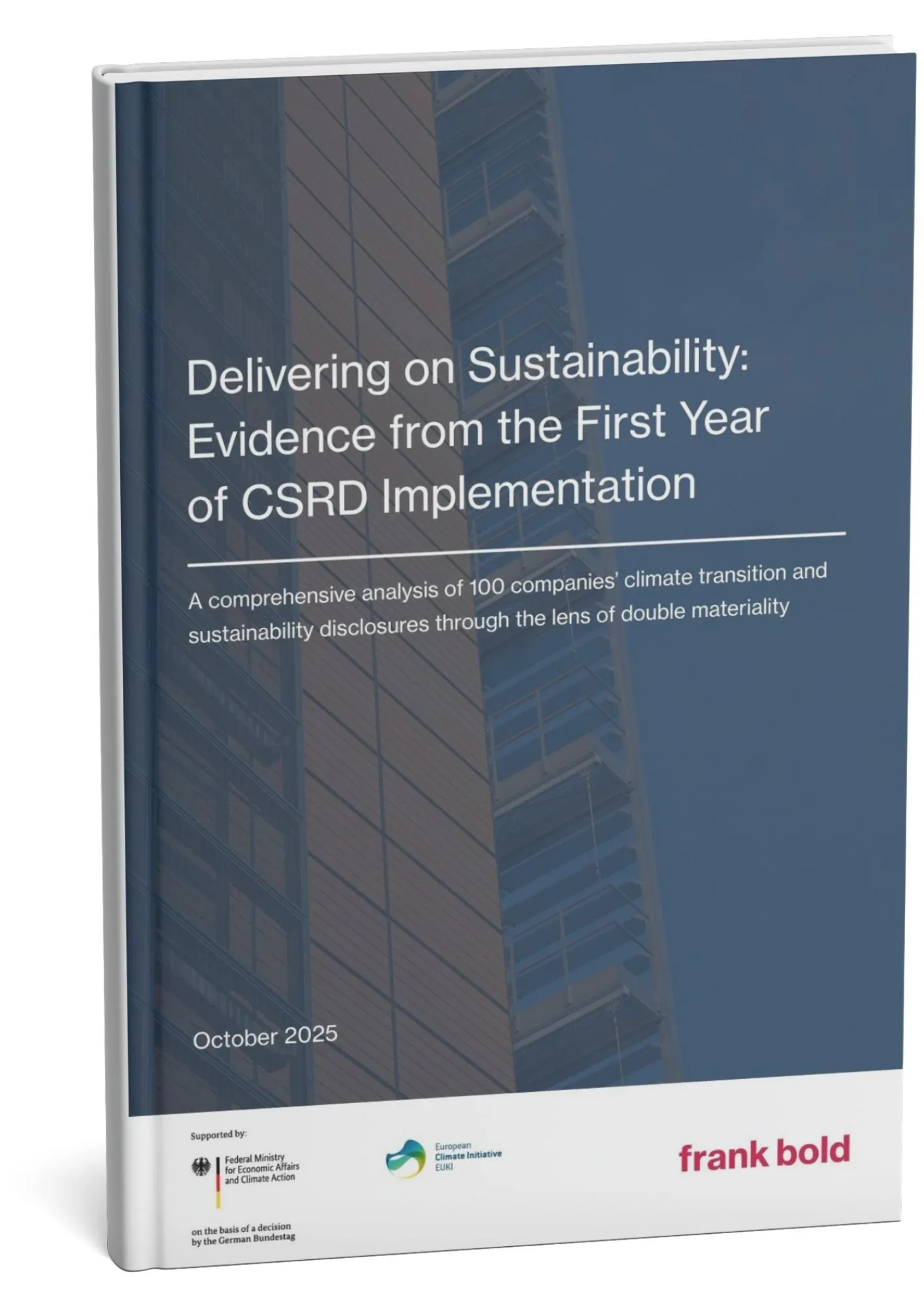
Discover how European companies are managing ESG reporting. The new study by Frank Bold’s Responsible Companies team summarizes the first wave of sustainability reports from one hundred major European companies and shows that reporting under the CSRD provides valuable data for decision-making and is becoming an effective tool for risk management. Publication is part of the European Climate Initiative (EUKI) of the German Federal Ministry for Economic Affairs and Climate Action (BMWK).

Comprehensive Sustainability Report aligned with CSRD.
.webp)
A simplified ESG report for your business partners.

Mapped according to GHG Protocol Product Standard.
We are part of the Frank Bold Expert Group
Copyright ©
Aktuální rok script
Frank Bold