The EU is changing its sustainability requirements for businesses. What will the approved Omnibus I package bring?
10.12.2025
After a year of intensive political negotiations, the EU has reached an agreement on the Omnibus 1 package, which fundamentally changes corporate obligations in ESG reporting, due diligence, and other areas. The agreement still needs to be formally approved by the European Parliament, which is expected to happen in the coming days.
From Frank Bold Advisory, we bring you below a summary of all the changes and their impacts on companies.
The newly approved version of the Omnibus package narrows the range of companies subject to the obligations under the CSRD (Corporate Sustainability Reporting Directive) and the CSDDD (Corporate Sustainability Due Diligence Directive). It also introduces further restrictions in the area of supply chains, eliminates some key requirements, and introduces new review clauses.
Key changes in the Omnibus package and their impacts on companies
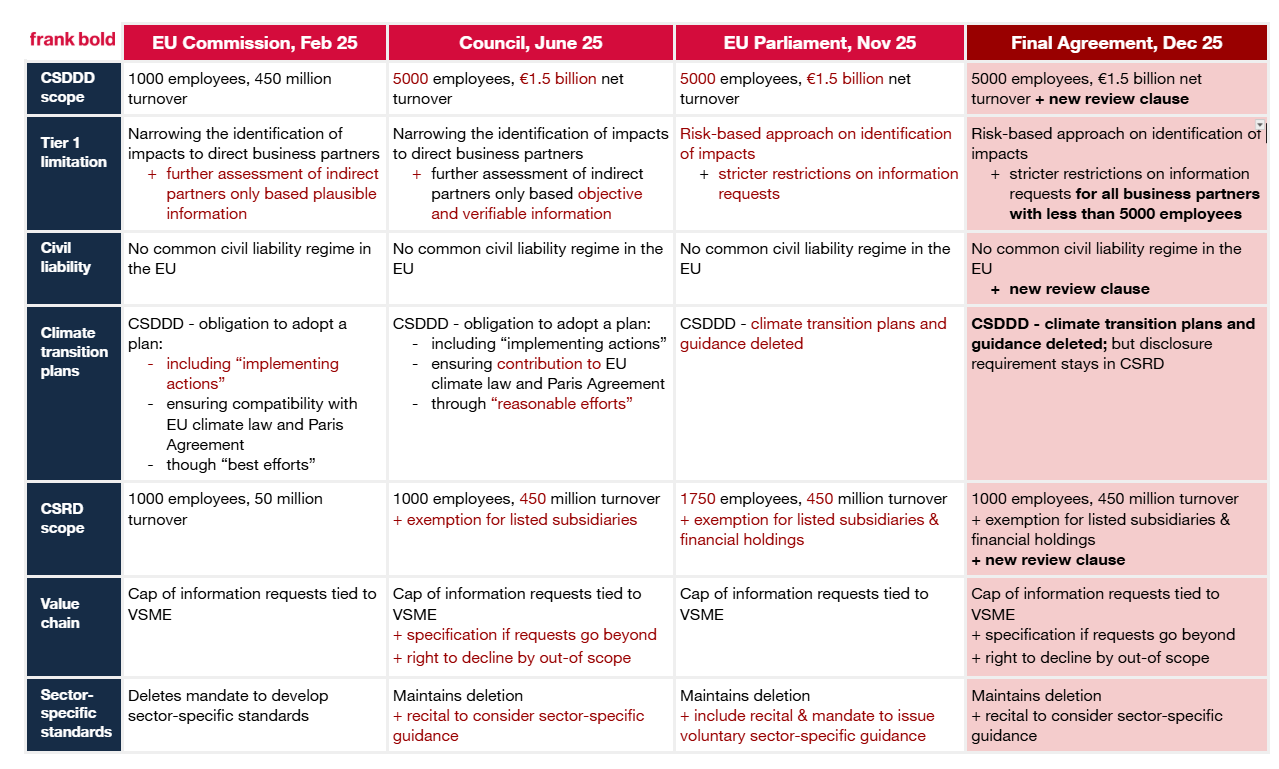
Due diligence obligations (CSDDD) only for the largest corporations
A new threshold for companies: more than 5,000 employees and EUR 1.5 billion in net turnover.
New element: review clause – the possibility to revise the scope in the future.
Supplier information limitations
A risk-based approach is being introduced for identifying impacts in the value chain.
Strict limitations on information requests from partners with fewer than 5,000 employees.
Impact: Companies will have limited options for obtaining ESG data from smaller suppliers, which may complicate voluntary reporting.
Civil liability
Abolition of the unified civil liability regime in the EU.
A review clause has been added for possible future amendments.
Impact: Lower legal risk for companies, but also weaker protection for affected parties.
Climate Transition Plans
CSDDD: the obligation to have a climate plan has been completely removed.
CSRD: the obligation to disclose information on the climate plan remains in place, or to state whether and when the company plans to adopt one.
Impact: Companies outside the CSRD will not have to address climate strategies, but large enterprises will.
ESG reporting under the CSRD
A new threshold for companies: more than 1,000 employees and EUR 450 million in turnover.
Exceptions: for listed subsidiaries and financial holdings.
Review clause added.
Value chain and VSMEs (Very Small and Medium Enterprises)
Limit for information requests: companies may request only data according to the voluntary VSME standard (originally intended for SMEs with up to 250 employees).
If the requirements exceed the scope of VSME, the supplier has the right to refuse.
Impact: Complications for companies that want detailed ESG data from smaller suppliers.
Sector standards
Definitive cancellation of mandatory sector-specific standards.
Only a recommendation to consider the sector-specific guidelines, without a deadline for their issuance.
Impact: Companies in high-risk sectors (e.g., energy, agriculture) will lose clear methodological guidance.
Overview table. Comparison of the original proposals and the final version in the last column.
Consult the next steps with us
At Frank Bold Advisory, we help you navigate the current requirements of the European CSRD directive as well as the ongoing changes of the so-called Omnibus. We will guide you through the preparation of an effective ESG report in line with the ESRS standards – whether you’re just starting out or need to improve existing processes. We work with major market players as well as smaller companies in supply chains – from the initial analysis and selection of key indicators all the way to the final reporting.
Discover how European companies are managing ESG reporting. The new study by Frank Bold’s Responsible Companies teamsummarizes the first wave of sustainability reports from one hundred major European companies and shows that reporting under the CSRD provides valuable data for decision-making and is becoming an effective tool for risk management. Publication is part of the European Climate Initiative (EUKI) of the German Federal Ministry for Economic Affairs and Climate Action (BMWK).


.webp)