
The Omnibus 1 package fundamentally changes the conditionsunder which companies subject to mandatory reporting under the CSRD and CSDDDcan obtain ESG data from their suppliers. The new rule, known as the ValueChain Cap, limits the scope of information that can be required from smallersuppliers. For companies with more complex supply chains, this creates legaluncertainty and practical complications in data collection. At Frank Bold Advisory,we’ll help you set up processes so you can obtain the necessary data incompliance with the new rules.
The Value Chain Cap imposes a limit on the informationrequirements that companies—which are required to report under the CSRD—can imposeon their suppliers with fewer than 1,000 employees. The scope ofpermissible requirements is based on the Voluntary Standard for Small andMedium-Sized Enterprises (VSME). The law thus defines what you are not allowedto request from these partners for reporting purposes, and the list is quite extensive.
For example, suppliers with 10 to 1,000 employees cannotbe required to provide data on Scope 3 emissions, information on climaterisks or the presence of operations in biodiversity-sensitive areas,emission reduction targets, or a description of transition policies,certifications, and eco-labels—including EMAS or ISO 14001— water consumptionin water-stressed areas, data on material use or pollution, gender pay gap indicators,the extent of reliance on workers who do not fall under the “employee” category,convictions and fines for corruption and bribery, or information on the scopeof human rights policies or measures taken.
Very small suppliers with fewer than 10 employees, however, cannot be required to provide anyenvironmental data for reporting purposes.
This data is crucial for calculating Scope 3 emissions, assessing climate risks, and monitoring environmentalimpacts. Its absence significantly complicates the preparation of acredible and comprehensive report.
Furthermore, a paradoxical situation arises: companiesoperating in jurisdictions with lower social and environmental standards areshielded from reporting requirements, while European manufacturers subject tostricter regulations are at a competitive disadvantage.
The Value Chain Cap does not apply to all situations. Keyexceptions:
· Climate risk management—for these purposes, data may be requested even beyond thecap.
· Voluntary data sharing—the cap does not prevent partners from voluntarilyproviding information.
· Sustainability due diligence—different, specific rules apply to due diligence in thesupply chain under the CSDDD.
· Purposes other than reporting—the cap does not apply to the collection of informationfor any legitimate purpose other than reporting.
Companies must fundamentally overhaul their datacollection processes throughout the value chain. It is therefore not enough tosimply send out the existing questionnaires; every request must comply withlegal requirements, while clearly distinguishing whether the cap applies to aspecific supplier.
In practice, this means:
1. Categorize suppliers bysize and determine which cap applies to them.
2. Specify and communicate a legitimate reason for each request that goes beyond the scope of the VSME.
3. Comply with the formal requirements set forth in the directive regarding communication andcontractual arrangements with protected entities.
4. Foster voluntary data sharing—partnerships based on collaboration and mutual supportare strategically more advantageous in this environment than a purelyprescriptive approach.
Setting up data collection processes in the supply chainin accordance with the new rules is both legally and operationally challenging.We will help you:
· Assess which data in your valuechain affects the cap and where exceptions exist thatcan be utilized.
· Establish legally soundprocesses for communicating with suppliers, including contractualdocumentation,
· Develop a strategy forvoluntarily sharing ESG data withsmaller partners that minimizes risks and improves the quality of data forreporting,
· Navigate the rules ofsustainability due diligence, wheredifferent regulations apply.
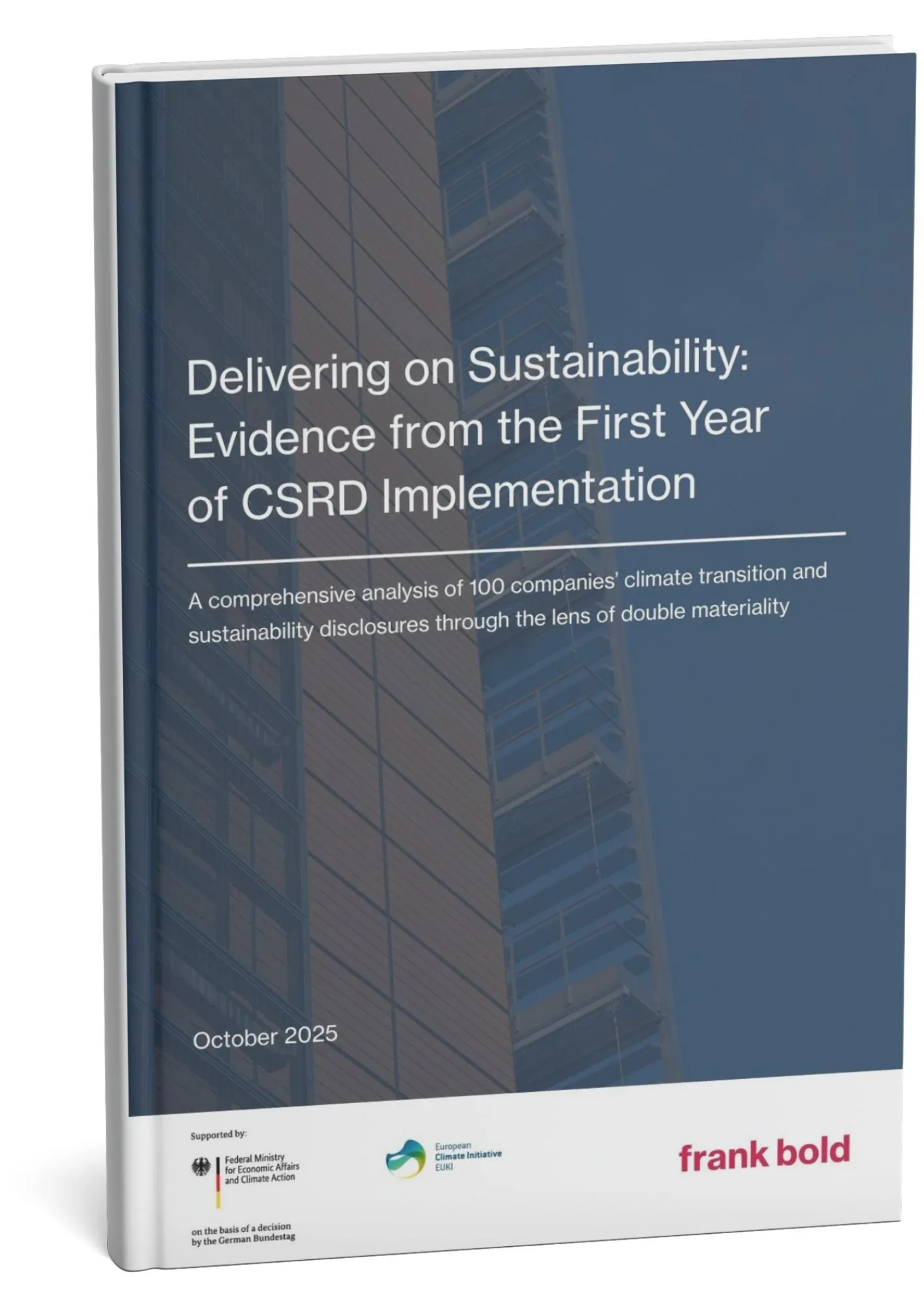
Discover how European companies are managing ESG reporting. The new study by Frank Bold’s Responsible Companies team summarizes the first wave of sustainability reports from one hundred major European companies and shows that reporting under the CSRD provides valuable data for decision-making and is becoming an effective tool for risk management. Publication is part of the European Climate Initiative (EUKI) of the German Federal Ministry for Economic Affairs and Climate Action (BMWK).

Comprehensive Sustainability Report aligned with CSRD.
.webp)
A simplified ESG report for your business partners.

Mapped according to GHG Protocol Product Standard.
We are part of the Frank Bold Expert Group
Copyright ©
Aktuální rok script
Frank Bold